 Dextra Light
How to Use UV Light to Protect Public Spaces in 2026?
How to Use UV Light to Protect Public Spaces in 2026? begins with a practical question: where can UV-C add measurable protection? The answer is not simply “everywhere.” Effective design depends on room volume, occupancy, airflow, exposure time, and maintenance. This is the central issue behind How UV Light Helps Protect Public Spaces.
The CDC’s Ventilation in Buildings guidance supports layered controls, including outdoor air, filtration, and germicidal ultraviolet systems. ASHRAE Standard 241-2023 also frames infection risk through equivalent clean airflow, rather than relying on one device. Industry guidance from the International Ultraviolet Association emphasizes that properly designed UV-C systems can inactivate airborne microorganisms. However, performance varies sharply between a crowded subway platform and a quiet library.
William P. Bahnfleth, Ph.D., an ASHRAE Fellow and leading UVGI researcher, has repeatedly stressed a simple principle: “There is no silver bullet.” That warning should guide every public-space project. UV-C fixtures need shielding, interlocks, commissioning, and scheduled cleaning. They must protect occupants from direct exposure while treating air or surfaces safely. A 2023 review in Indoor Air also reinforces the importance of combining ultraviolet technology with ventilation and filtration.
The evidence is promising, but not tidy. A hallway is not a laboratory. Dust can block lamps, poor airflow can create untreated zones, and replacement costs are easy to underestimate. This article examines practical layouts, safety controls, verification methods, and procurement questions for 2026. Its goal is modest: stronger protection, fewer assumptions, and decisions supported by credible engineering evidence.
Understanding How UV Light Can Protect Public Spaces in 2026
UV light can help protect public spaces in 2026, but its value depends on careful design. Germicidal UV-C targets microorganisms by damaging their genetic material. It works best as one layer within a wider hygiene plan. Ventilation, filtration, cleaning, and occupancy control still matter.
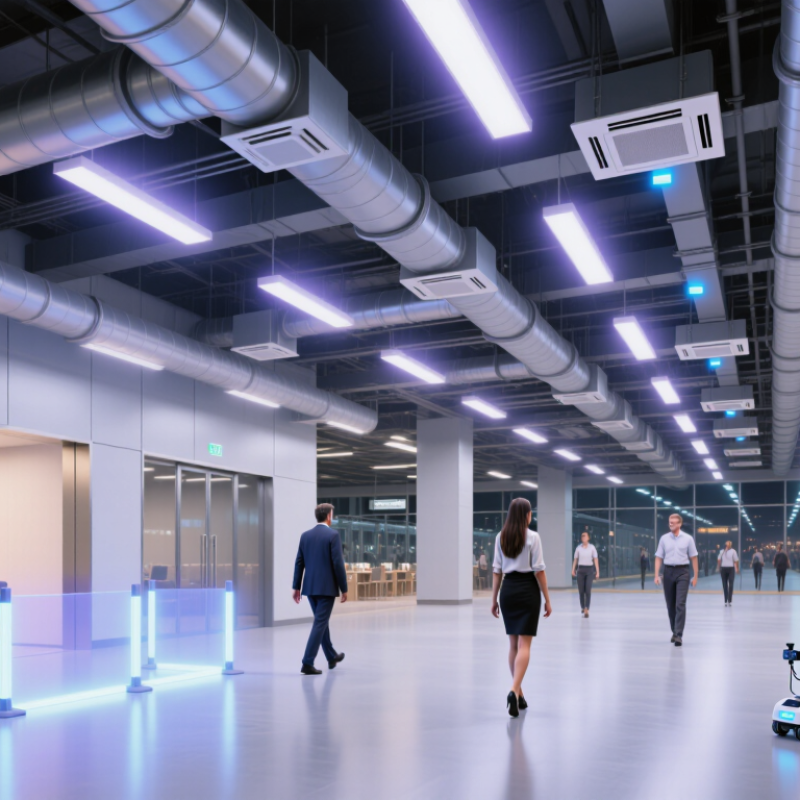
In a library, UV-C fixtures may treat air above people’s heads. Fans move contaminated air through the disinfecting zone. In transport hubs, enclosed systems can treat air inside ducts without exposing passengers. Sensors, shields, automatic shutoffs, and clear warning labels are essential. Direct exposure can injure eyes and skin. Installation should follow current public health guidance and involve qualified technicians.
Performance requires measurement, not optimism. Operators should record lamp age, airflow, room height, exposure levels, and maintenance checks. Dust can reduce output, even when a lamp still appears bright. A quiet room may feel protected while receiving little useful dose. That is an uncomfortable possibility.
Some systems may also create ozone or other byproducts if poorly selected. Independent testing and regular inspection reduce that risk. Staff need simple training, especially when furniture or ceiling layouts change. UV-C is not a magic shield. It can lower airborne risk, yet results vary between spaces. My own preference would be cautious deployment, transparent monitoring, and honest communication when evidence remains incomplete.
How to Use UV Light to Protect Public Spaces in 2026? — Understanding How UV Light Can Protect Public Spaces in 2026
| Protection Dimension | Evidence-Based Data | Recommended Public-Space Application | Safety or Design Requirement | Reference Basis |
|---|---|---|---|---|
| Germicidal wavelength | Ultraviolet-C radiation is generally defined as ultraviolet radiation from 200 to 280 nanometres (nm). It can damage the nucleic acids of microorganisms and prevent them from replicating. | Use UV-C as a supplementary control in locations such as transit facilities, schools, healthcare waiting areas, offices, and other shared indoor spaces. | UV-C should supplement, not replace, ventilation, filtration, cleaning, vaccination, and other public-health measures. | U.S. Centers for Disease Control and Prevention; World Health Organization |
| Conventional UV-C source | Low-pressure mercury UV-C systems commonly produce radiation near 254 nm, a wavelength widely used for germicidal ultraviolet irradiation. | Use properly engineered upper-room UVGI systems or enclosed air-treatment units where occupied-room treatment is required. | Direct exposure to 254 nm radiation must be prevented through shielding, positioning, access control, and commissioning measurements. | ASHRAE ultraviolet air and surface treatment guidance; NIOSH ultraviolet germicidal irradiation guidance |
| Far-UVC option | Far-UVC commonly refers to shorter-wavelength UV-C, often around 222 nm. Research indicates potential for reducing airborne microorganisms, but long-term safety, installation quality, and real-world performance must still be evaluated for each application. | Consider only systems supported by wavelength-specific safety testing, independent verification, and local regulatory review. | Do not assume that a “far-UVC” label means unrestricted exposure is safe. Ozone generation, skin exposure, eye exposure, and material compatibility must be assessed. | International Commission on Non-Ionizing Radiation Protection; peer-reviewed ultraviolet safety research |
| Exposure limit at 254 nm | The ICNIRP wavelength-dependent exposure limit for 254 nm ultraviolet radiation is approximately 6 mJ/cm² over an eight-hour period. | Use this value as an occupational exposure-control benchmark when evaluating occupied areas, subject to applicable local regulations. | Radiant exposure must be measured in the occupied zone. A qualified professional should verify that direct and reflected UV-C remain below the applicable limit. | ICNIRP Guidelines on Limits of Exposure to Ultraviolet Radiation of Wavelengths Between 180 nm and 400 nm |
| Exposure limit at 222 nm | The ICNIRP wavelength-dependent exposure limit for 222 nm ultraviolet radiation is approximately 23 mJ/cm² over an eight-hour period. | Use only as a wavelength-specific planning reference; it is not a substitute for product testing, exposure assessment, or regulatory approval. | The exposure limit applies to the weighted biological effect of the radiation, not simply the nominal lamp output. Optical filters and spectral emissions must be verified. | ICNIRP Guidelines on Limits of Exposure to Ultraviolet Radiation of Wavelengths Between 180 nm and 400 nm |
| Upper-room UVGI | Upper-room ultraviolet germicidal irradiation treats air in the upper portion of a room while occupants remain below the irradiated zone. | Install fixtures above the occupied zone in rooms with adequate ceiling height and sufficient air mixing, such as classrooms, waiting areas, and transport hubs. | Fixtures require correctly designed louvers or shields. Airflow, ceiling height, room geometry, and occupant eye level must be assessed before installation. | ASHRAE and CDC upper-room germicidal ultraviolet guidance |
| In-duct air treatment | UV-C installed inside air-handling equipment can irradiate recirculated air without exposing occupants directly. | Use in HVAC ducts, air-handling units, and dedicated air-cleaning equipment where airflow and UV dose can be controlled. | The system must account for air velocity, irradiance, residence time, reflectivity, lamp aging, temperature, and pressure drop. | ASHRAE ultraviolet air-treatment guidance |
| Surface-disinfection use | UV-C effectiveness on surfaces depends on delivered dose, distance, shadowing, surface texture, organic material, and the target microorganism. | Use enclosed or unoccupied-room systems for selected surfaces after people, animals, and plants have been removed. | UV-C cannot reliably disinfect shaded areas. Manual cleaning is required before treatment when dirt or organic material blocks the radiation. | U.S. Environmental Protection Agency and CDC ultraviolet disinfection guidance |
| Air-quality integration | UV systems do not remove carbon dioxide, dust, or all chemical pollutants. Ventilation and filtration address different indoor-air-quality objectives. | Combine UVGI with outdoor-air ventilation, mechanical filtration, and occupancy-based air-quality monitoring. | System performance should be evaluated against the building’s ventilation and filtration targets rather than treated as a standalone solution. | ASHRAE indoor environmental quality and ventilation guidance |
| Ozone control | Some ultraviolet sources can generate ozone, particularly when they emit wavelengths below approximately 240 nm. | Specify ozone-free or ozone-controlled equipment for occupied public spaces unless a dedicated ozone-management design is provided. | Verify spectral output and measure or certify ozone emissions. Ozone must not be used as an uncontrolled substitute for UVGI. | U.S. Environmental Protection Agency indoor-air guidance; ultraviolet equipment safety standards |
| Commissioning and monitoring | Actual UV performance changes with lamp aging, dust accumulation, temperature, airflow, reflector condition, and operating time. | Commission the system before occupancy and include periodic irradiance, airflow, interlock, and shielding checks in the maintenance plan. | Keep installation records, measurement results, maintenance dates, replacement schedules, and incident procedures. | ASHRAE and NIOSH UVGI engineering guidance |
| Human exposure controls | Uncontrolled UV-C exposure can injure the eyes and skin. Symptoms may be delayed after exposure. | Use occupancy sensors, door interlocks, warning labels, restricted access, remote controls, and trained operators for unoccupied-room systems. | Never operate an exposed UV-C device in an occupied area unless it has been specifically designed, installed, and verified for safe occupied use. | U.S. Food and Drug Administration; NIOSH occupational safety guidance |
| Material compatibility | Repeated UV-C exposure can degrade polymers, elastomers, fabrics, coatings, artwork, and other sensitive materials. | Use UV-C mainly in air-treatment applications where possible, and assess material exposure before surface or room treatment. | Inspect vulnerable materials during scheduled maintenance and follow the equipment supplier’s verified compatibility data. | NIOSH and ultraviolet equipment safety guidance |
| 2026 implementation priority | Risk reduction is strongest when UVGI is integrated into a layered indoor-air strategy rather than deployed as a single intervention. | Prioritize high-occupancy, poorly mixed, or higher-risk spaces after assessing ventilation, filtration, occupancy, room geometry, and maintenance capacity. | Require a documented risk assessment, professional design review, commissioning report, worker training, and periodic reassessment. | CDC, WHO, ASHRAE, ICNIRP, and public-building engineering practice |
FAQS
UV-C can reduce airborne microorganisms by damaging their genetic material. It works best as one layer in a wider hygiene plan. Ventilation still matters.
They may treat air in libraries, schools, clinics, and transport hubs. Enclosed systems can disinfect air inside ducts. Direct exposure must be prevented.
No. UV-C does not replace cleaning, filtration, ventilation, or occupancy control. A dusty room still needs cleaning. Layered protection is more realistic.
Operators should record irradiance, delivered dose, airflow, and lamp age. They should inspect fixed points regularly. A bright lamp may deliver little useful dose.
Dust, blocked vents, weak airflow, and aging lamps can reduce output. Furniture changes may also affect air movement. Quiet operation proves nothing.
Use shields, sensors, interlocks, warning labels, and automatic shutoffs. Prevent direct exposure to eyes and skin. Never rely on a timer alone.
Some poorly selected systems may create ozone or other byproducts. Independent testing and regular inspections can reduce this risk. Selection deserves caution.
Recheck airflow, room height, occupancy, and exposure levels. Update the risk assessment and maintenance records. A small layout change can alter safety.
Keep calibration records, inspection reports, maintenance logs, and incident reports. Record corrective actions clearly. Compliance can change over time.
No. Tests may miss crowded periods or unusual airflow patterns. Measurements can look precise yet remain incomplete. That limitation deserves honest communication.
Conclusion
How UV Light Helps Protect Public Spaces begins with understanding how ultraviolet technology can reduce airborne and surface microorganisms when used under controlled conditions. In 2026, public facilities may consider different solutions for schools, transportation hubs, healthcare settings, offices, and other shared environments. The safest choice depends on occupancy, room size, ventilation, exposure limits, and whether the system operates in occupied or unoccupied areas.
Effective planning requires careful placement, operating schedules, shielding, airflow management, and professional installation. UV systems should never create direct exposure risks for people, pets, or sensitive materials. Responsible operation includes clear procedures, regular maintenance, staff training, and restricted access where necessary. Facilities should also monitor air quality, equipment performance, and potential safety concerns through documented inspections and testing. By combining suitable UV technology with cleaning, ventilation, and public-health practices, organizations can improve protection while supporting regulatory compliance and maintaining a safe, reliable environment for everyone.
